Communication Port PLC Parameters
Communication Port
- The Communication Port PLC parameter encompasses the Ch 1 and Ch 2 PLC parameters for serial communication.
Ch 1
| Supported PLC Series |
|---|
| XPnF | XPnE | CPnE/F | CP4C/D/U | CP | PLC-S |
|---|
| ✓ | ✓ | ✓ | ✓ | ✓ | ✓ |
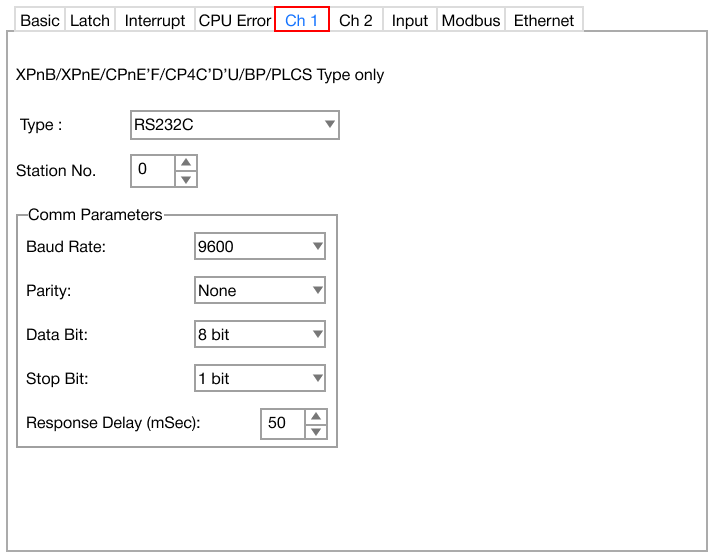
- The default communication type for channel 1 is RS-232(C).
- The station number is a unique identifier typically used for Modbus.
- The value range is 0 ~ 254.
- The baud rate is the communication speed in bit per second (bps).
- The ranges are:
- 300
- 600
- 1,200
- 2,400
- 4,800
- 9,600
- 19,200
- 38,400
- 57,600
- 115,200
- The parity is used for error checking in data transmission.
- This can be set to odd or even.
- The data bit specifies the number of bits in a packet.
- This can be set to 7 or 8 bits.
- The stop bit defines the end of a packet.
- This can be set to 1 or 2.
- The response delay is the time, in milliseconds, before the PLC expects a response from the serial device.
Ch 2
| Supported PLC Series |
|---|
| CP4F | PLC-S |
|---|
| ✓ | ✓ |
- The default communication type for channel 1 is RS-422/RS-485.
- The station number is a unique identifier typically used for Modbus.
- The value range is 0 ~ 254.
- The baud rate is the communication speed in bit per second (bps).
- The ranges are:
- 300
- 600
- 1,200
- 2,400
- 4,800
- 9,600
- 19,200
- 38,400
- 57,600
- 115,200
- The parity is used for error checking in data transmission.
- This can be set to odd or even.
- The data bit specifies the number of bits in a packet.
- This can be set to 7 or 8 bits.
- The stop bit defines the end of a packet.
- This can be set to 1 or 2.
- The response delay is the time, in milliseconds, before the PLC expects a response from the serial device.