CM3 High-Speed Counter Module Features
CM3 HSC Module
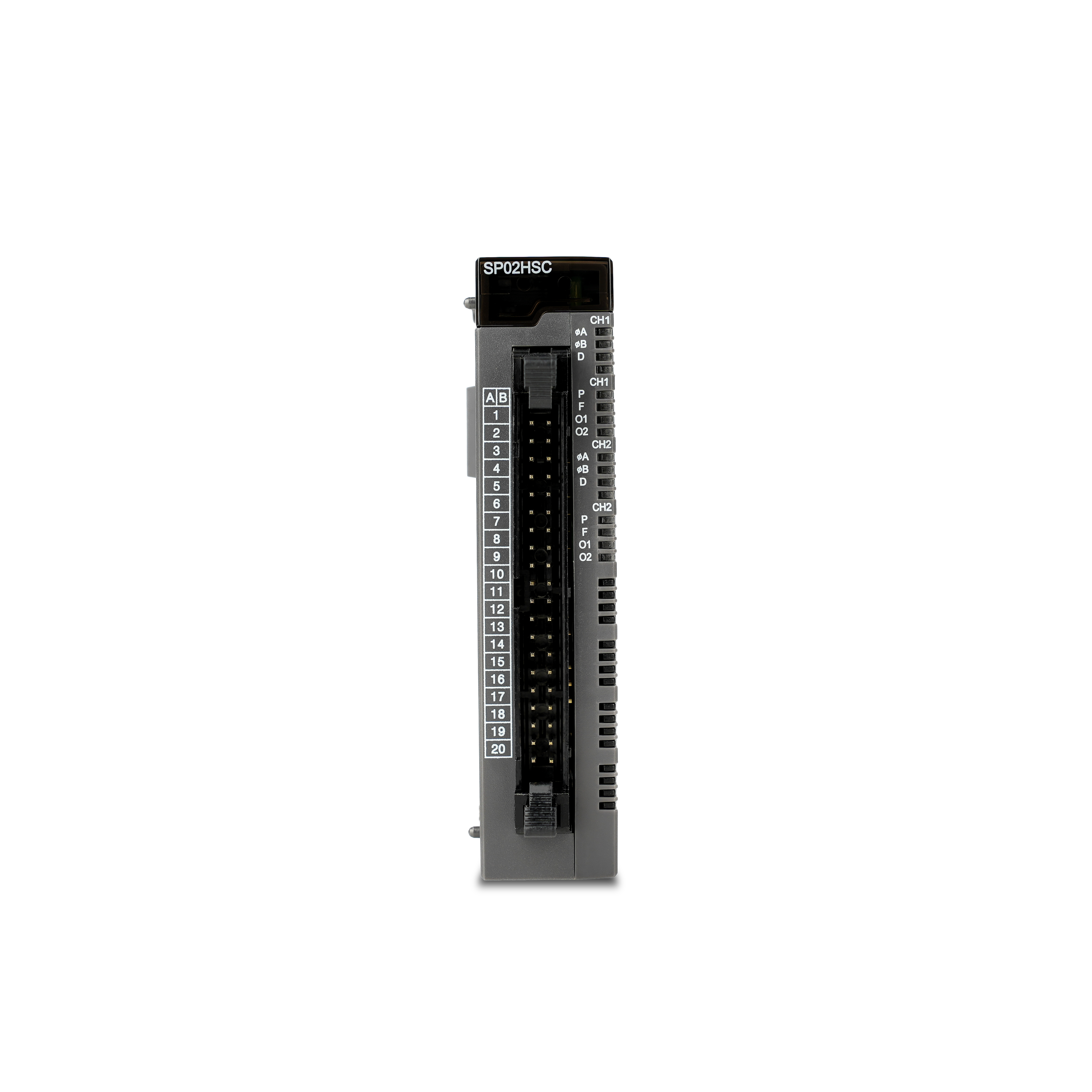
The CM3-SP02HSC module provides 16 I/O points and supports two channels of pulse input for high-speed counting tasks. It works with PNP/NPN universal encoders (open collector type) and is capable of handling up to 200,000pps. It is ideal for simpler, single-ended input configurations where speed and flexibility are required.
The CM3-SP02HSD module also features 16 I/O points and 2 channels, but it supports line-drive (differential input) types, making it suitable for more demanding applications. It boasts a higher pulse processing capability, reaching up to 500,000pps with RS-422A line drivers. This makes it a better choice for systems requiring higher speed and noise immunity.
Features
The CM3-SP02HSC and the CM3-SP02HSD modules support the following features:
- Pulses in a wide range can be counted.
- The range is -2,147,483,648 ~ 2,147,483,647 (signed 232).
- A counted value is saved in buffer memory as a signed 32-bit binary value.
- The pulse input type can be selected.
- 1-Phase Input 1-Multiplication (1-p input 1-m)
- 1-Phase Input 2-Multiplication (1-p input 2-m)
- Clockwise/Counter-Clockwise
- 2-Phase Input 1-Multiplication (2-p input 1-m)
- 2-Phase Input 2-Multiplication (2-p input 2-m)
- 2-Phase Input 4-Multiplication (2-p input 4-m)
- The counting form can be selected.
- Linear counting:
- Input pulses are counted from -2,147,483,648 ~ 2,147,483,647.
- If the value is out of range, overflow occurs.
- Input pulses are counted from -2,147,483,648 ~ 2,147,483,647.
- Ring counting:
- Input pulses are counted repeatedly between the minimum and maximum values.
- Linear counting:
- Coincidence output is available.
- Output can be toggled ON or OFF by comparing the current value with a set coincidence value.
- Four counting functions can be selected.
- Latch counting:
- The currently counted value is saved in buffer memory 4 (04H), 5 (05H), 36 (24H), and 37 (25H).
- This is according to the signal to begin counting, Yn.6 and Yn.E.
- n is the module's position in the chassis.
- This is according to the signal to begin counting, Yn.6 and Yn.E.
- The currently counted value is saved in buffer memory 4 (04H), 5 (05H), 36 (24H), and 37 (25H).
- Sampling counting:
- The value counted for the time set by the signals to start counting, Yn.6 and Yn.E, is saved in buffer memory 6 (06H), 7 (07H), 38 (26H), and 39 (27H).
- If a set time has passed, the value counted before signals Yn.6 and Yn.E are input will be kept.
- The value counted for the time set by the signals to start counting, Yn.6 and Yn.E, is saved in buffer memory 6 (06H), 7 (07H), 38 (26H), and 39 (27H).
- Periodic pulse counting:
- The values saved in buffer memory 8 (08H), 9 (09H), 40 (28H), and 41 (29H) counted before the time set up by the signals Yn.6 and Yn.E are currently counted values, saved in buffer memory 10 (0AH), 11 (0BH), 42 (2AH), and 43 (2BH) are saved in buffer memory.
- Disable Counting :
- If the signals, Yn.6 and Yn.E, or the signals to enable count, Yn.4 and Yn.C, are OFF (0), pulses will not be counted.
- The counted values are accumulated in buffer memory 0 (0H) and 1 (01H) for saving the current count.
- If the signals, Yn.6 and Yn.E, or the signals to enable count, Yn.4 and Yn.C, are OFF (0), pulses will not be counted.
- Latch counting:
- The preset and counting function can be processed by outer control signals.